The robustness of event cameras to high dynamic range and motion blur holds the potential to improve visual odometry systems in challenging environments. Although their high temporal resolution does not require synchronous processing, most event-based odometry methods still run at fixed rates, which simplifies system design but restricts latency and throughput. In this work, we present AERO-VIS, a stereo event-inertial SLAM system with an integrated, data-driven, robust, and performance-optimized keypoint detector. By decoupling event preprocessing from state estimation, our architecture operates asynchronously at the maximum rate supported by available hardware, dynamically adapting to downstream runtime demands and ensuring low-latency, real-time performance. When deploying AERO-VIS on a UAV, we achieve unprecedented accuracy in onboard event-based SLAM. These unique characteristics enable us to present the first purely event-based inertial SLAM system that demonstrates closed-loop UAV control and large-scale state estimation while relying solely on onboard compute.

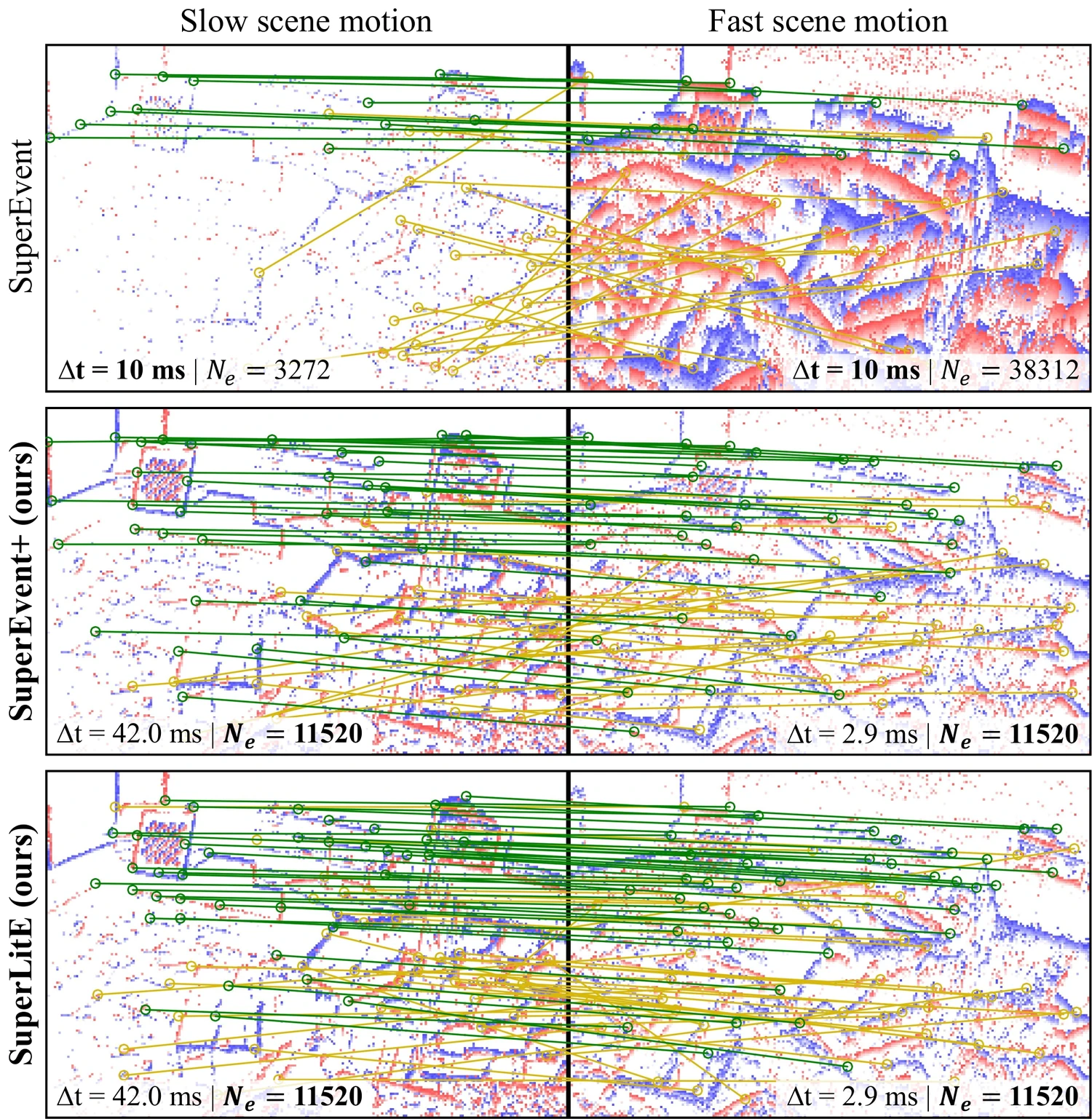
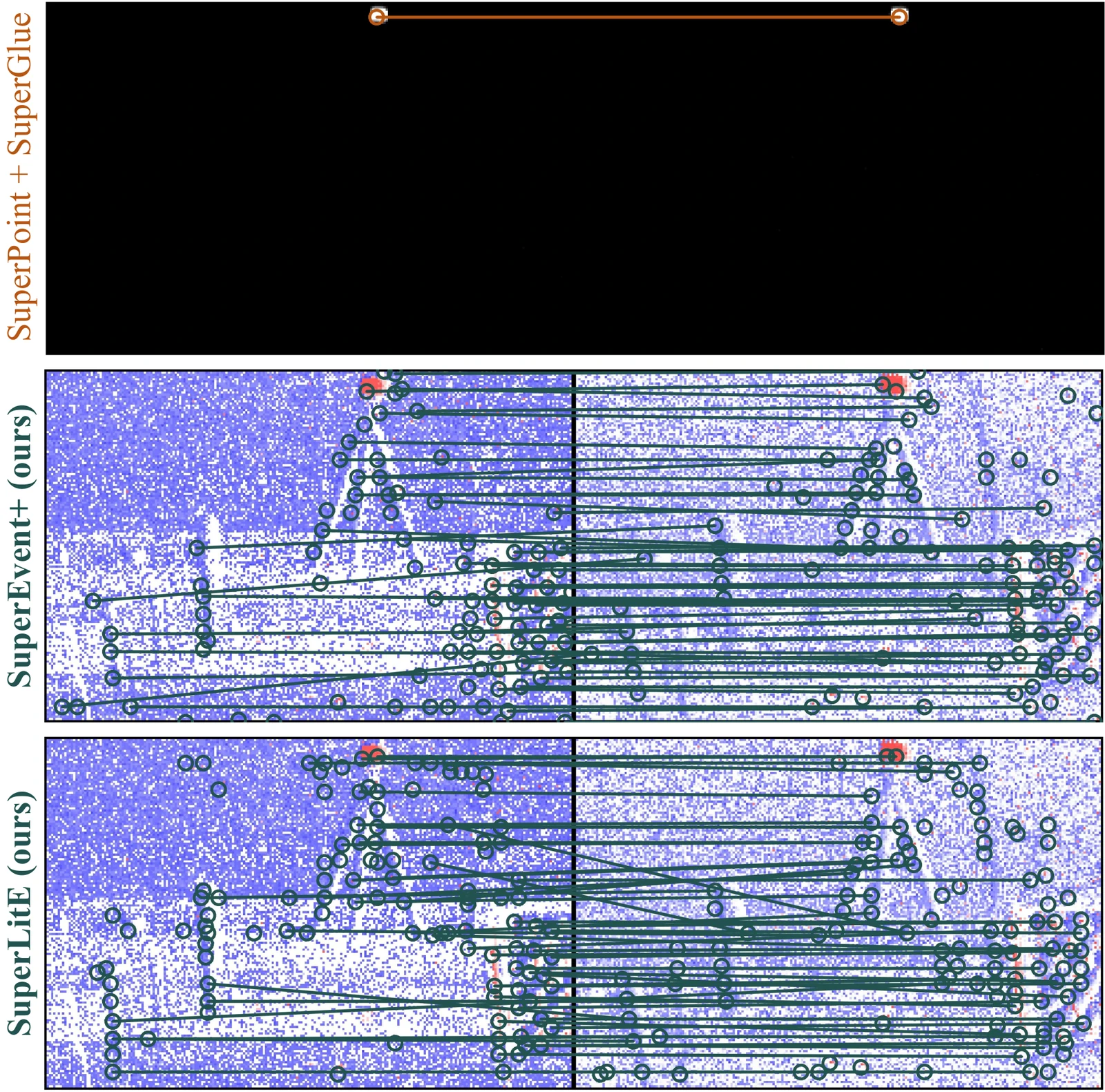
SuperEvent+ raises AUC@10° by 18.7 % over the SuperEvent baseline through our refined MCTS formulation, while SuperLitE keeps a 15.0 % gain at 10.5× lower inference latency.
AERO-VIS is the only evaluated system capable of reliable onboard state estimation, and on most sequences its real-time Jetson results beat both baselines' unconstrained desktop runs.
Arithmetic mean of the per-sequence RMS absolute trajectory error, each sequence itself the median of 5 runs. ESVO2 is omitted where it diverged or crashed on at least one sequence of a dataset. Note the differing axis scale per dataset: rpg-stereo and TUM-VIE are small-scale, VECtor is large-scale. Per-sequence numbers are in the paper.
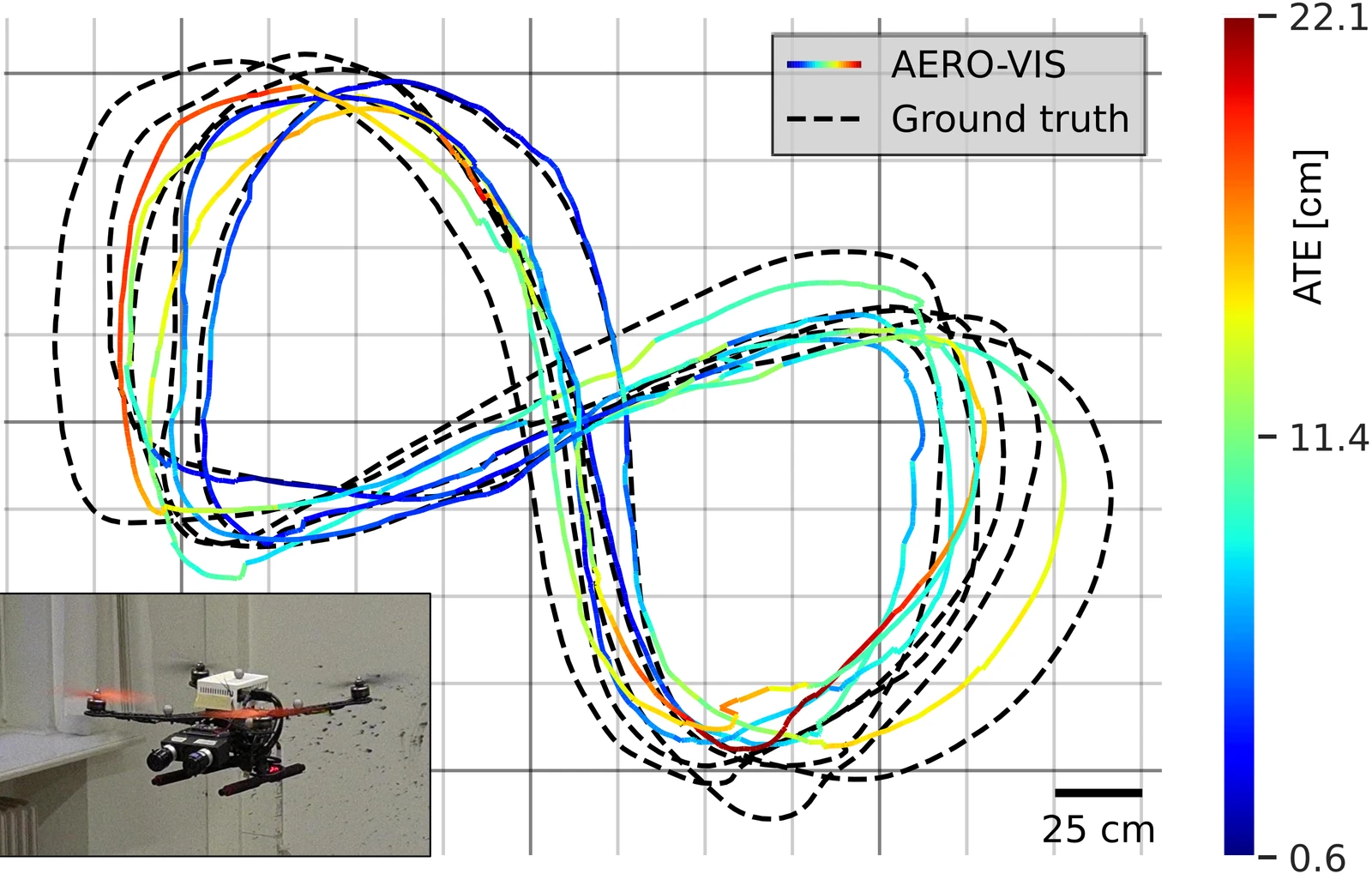
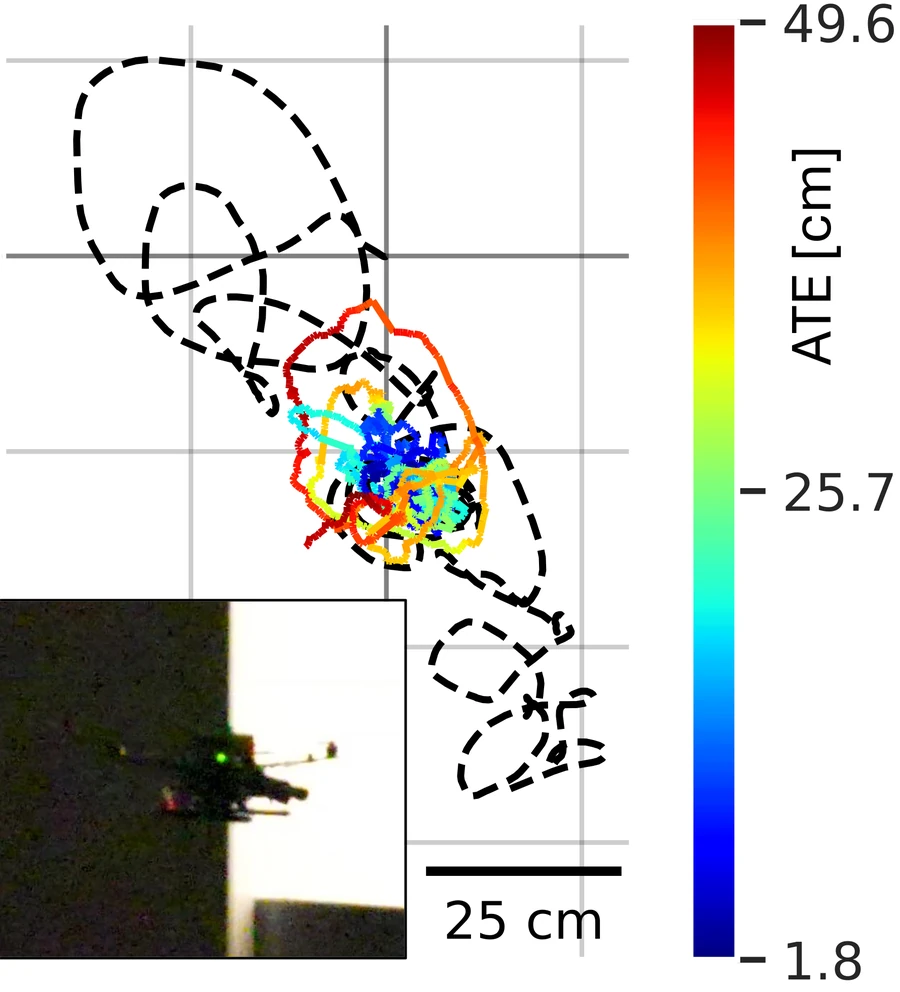
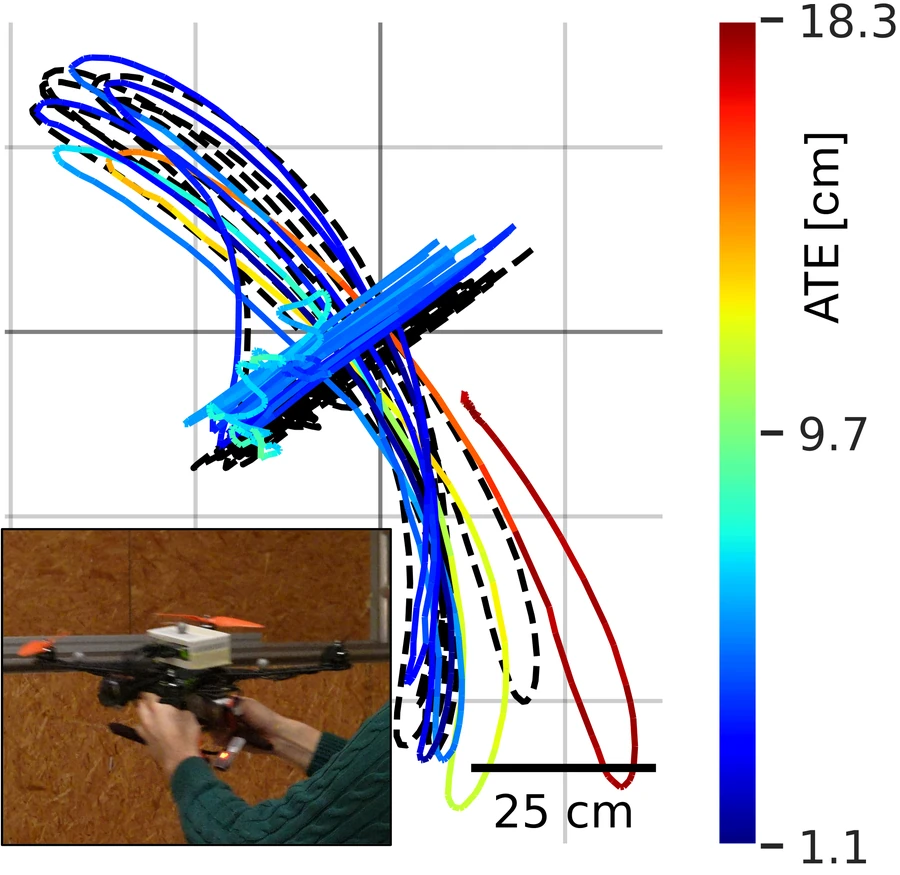
Onboard a custom UAV with a Jetson Orin NX and two Prophesee EVK4 cameras: frame-based OKVIS2 wins under normal light, but fails in HDR — crashing the drone — and AERO-VIS cuts the error by 90 % under aggressive motion.
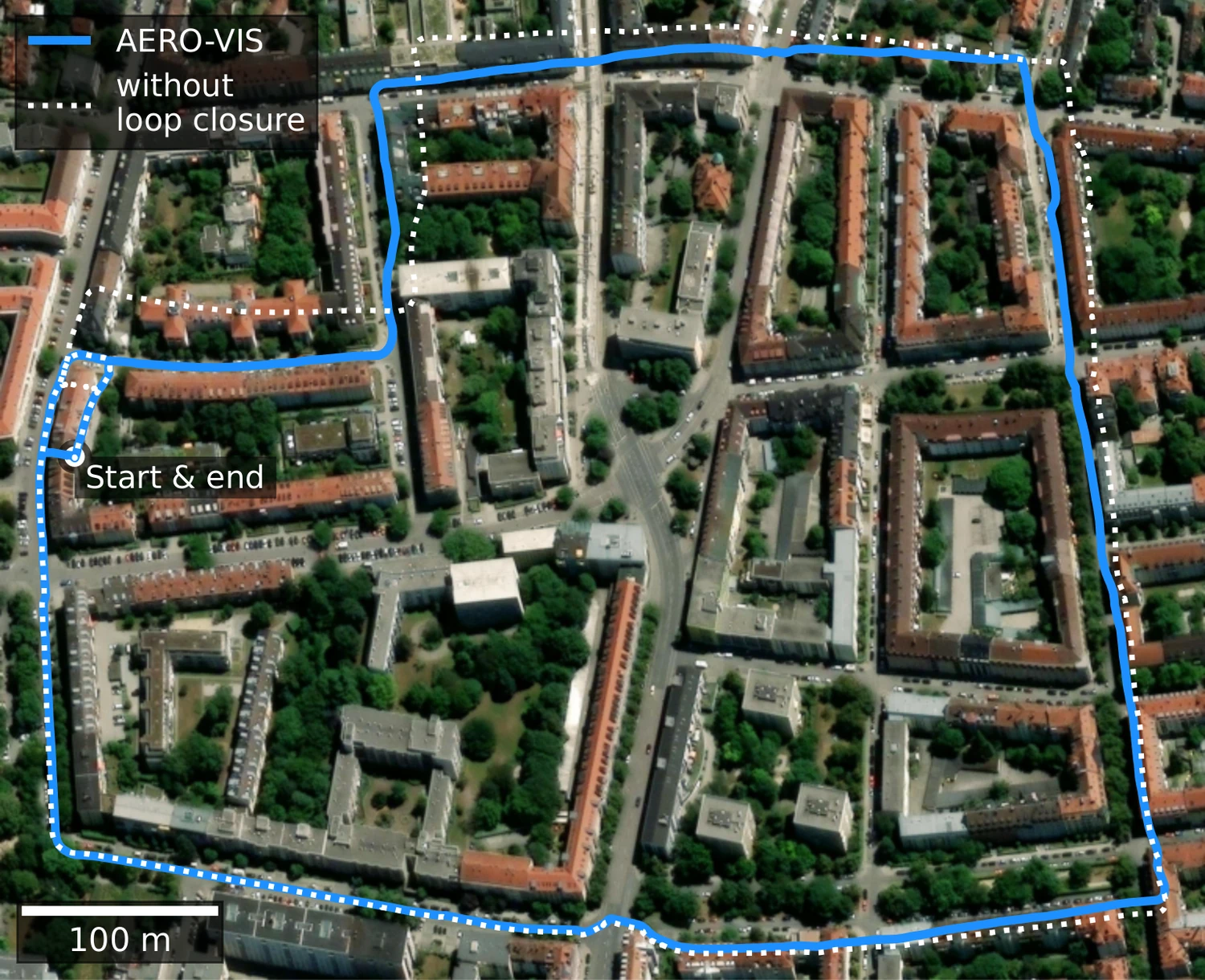
A 2 km urban walk in 20 min, estimated entirely onboard; loop closure corrects a drift of 1.8 % of the traversed distance. The route runs through varying lighting (sun, shade, artificial light) and dynamic entities — cars, pedestrians, bicycles. Without ground truth, the accuracy shows in how closely the estimate follows the street layout. The initial pose was manually aligned with the map.
High dynamic range is one of the defining advantages of event cameras, and our Multi-Channel Time Surface reformulation preserves it. Among the EDS evaluation sequences, one is recorded explicitly for HDR testing — ziggy_and_fuzz_hdr — and on it both SuperEvent+ and SuperLitE improve over the SuperEvent baseline by the same margin as on the remaining sequences. The qualitative example on the right illustrates the increased robustness to HDR compared to frame cameras.
| Method | EDS: AUC [%] | ||
|---|---|---|---|
| @5° | @10° | @20° | |
| SuperEvent | 27.4 | 39.9 | 50.8 |
| SuperEvent+ (ours) | 31.3 | 45.0 | 57.6 |
| SuperLitE (ours) | 31.2 | 45.3 | 58.3 |
SuperLitE is the outcome of a search over the MCTS formulation, the backbone architecture, the number of MCTS channels and the descriptor dimensionality. We additionally investigated how to reduce operations at large spatial resolutions (the early layers), which are the primary computational bottleneck in the VGG backbones. SuperEvent+ achieves the best overall accuracy, while SuperLitE offers the best accuracy/latency trade-off; reducing the channel count, descriptor dimension or network depth any further degrades prediction accuracy significantly. All 39 evaluated configurations are published here, since the full table did not fit within the page limit of the manuscript.
Every evaluated configuration, plotted as inference latency against relative pose estimation accuracy. The fixed-event-count formulation dominates the fixed-time-window formulation across the whole latency range. SuperLitE sits on the Pareto frontier at the knee: it is 10.5× faster than SuperEvent while still improving AUC@10° by 7.4 %. Hover a point for the full configuration.
Click a column header to sort; click it again to reverse, and a third time to restore the original ordering. Relative pose estimation AUC is reported at error thresholds of 5°/10°/20°. Inference times of the captured CUDA graph of the TensorRT-compiled models with 16-bit floating-point precision and 240 × 400 pixels input resolution are measured on an NVIDIA Jetson Orin NX. ΔAUC@10° and ΔLatency are computed relative to SuperEvent (first row, orange). Rows in blue and green are SuperEvent+ and SuperLitE. Bold marks the best and underline the second best result per column.
C denotes the number of input event/MCTS channels. VGG(a→b) denotes a VGG-block consisting of a 3×3 convolution from a to b channels, batch normalization and a ReLU activation; P denotes 2×2 maximum-pooling.
@article{burkhardt2026aerovis,
title={{AERO-VIS}: Asynchronous Event-based Real-time Onboard Visual-Inertial {SLAM}},
author={Burkhardt, Yannick and Barbas Laina, Sebasti\'an and Boche, Simon and Frei{\ss}muth, Leonard and Leutenegger, Stefan},
journal={IEEE Robotics and Automation Letters},
year={2026}
}